



CAIRO
ASWAN
LUXOR
Egypt Solar Eclipse August 2027
11-DAY
ITINERARY
THE HEART OF THE EXPERIENCE
This journey is built around a single, absolute focal point: the solar eclipse in Luxor—an event where the sky, temple geometry, and the ancient language of the sun converge in real time. Everything leading up to this moment is designed as deliberate preparation. It is an invitation to arrive smoothly, settle into Egypt’s staggering scale, and allow the mind to sharpen into stillness rather than rushing through the landscape.
The opening days in Cairo establish the vital structural foundations of the expedition, introducing Giza at first light and Saqqara at its absolute origin point. By experiencing these sites in the quiet morning hours, the monuments are encountered as deliberate systems of intention rather than isolated, historical icons. This initial grounding allows the group to read the ancient landscape with a deeper clarity before moving onward.
From the capital, the route shifts south into the warmer, deeper register of Upper Egypt to introduce a completely new cadence. Aswan brings the beautiful interplay of shifting river light and enduring granite permanence, while a pre-dawn journey to Abu Simbel at sunrise adds the crucial dimension of engineered alignment and long-range vision. This monumental cliffside encounter stands as a profound prelude—an explicit echo of the eclipse theme, masterfully expressed through stone.
The Nile then becomes the organizing axis of the entire experience. A privately chartered luxury dahabeya carries you north at the river’s own organic pace, allowing temple visits to emerge directly and seamlessly from the shoreline. Here, sailing is treated as a profound experience rather than mere transit—a necessary interval that lowers the internal tempo, integrates the intensity of the sights, and holds the group in a calm, continuous rhythm as Luxor approaches.
Luxor stands as the ultimate culmination of the journey. The grand ceremonial architecture of the East Bank and the West Bank’s deeper landscape of transformation form the definitive final frame around the eclipse itself. This is an arrival into ancient Thebes timed perfectly for the exact moment the sky delivers its rarest, most defining cosmic punctuation.
THE GEOGRAPHY
CAIRO • GIZAPyramids of the Giza Plateau
Great Sphinx
Valley Temple
GEM
SAQQARASaqqara Necropolis
Step Pyramid of Djoser
ASWANPhilae Temple
Unfinished Obelisk
ABU SIMBELGreat Temple of Ramesses II
Temple of Queen Nefertari
KOM OMBODouble Temple of Sobek & Horus the Elder
Crocodile Museum
EDFUTemple of Horus
GEBEL EL-SILSILASandstone Quarry Cliffs
ESNATemple of Khnum
ABYDOSTemple of Seti I
DENDERATemple of Hathor
LUXOR – EAST BANKKarnak Temple
Luxor Temple
LUXOR – WEST BANKValley of the Kings
Temple of Hatshepsut
Colossi of Memnon
DETAILED ITINERARY
-
Welcome to Egypt 🇪🇬 ☀️
Ritual Moment
Gentle breathwork and intention-setting to mark the beginning of the journey.Overview
Arrival in Cairo is structured to reduce friction from the first step. Formalities are managed with efficiency and discretion, allowing the nervous system to transition gradually rather than abruptly. The day is intentionally light, to create stability and space before deeper layers of the journey unfold.Itinerary
VIP Fast-Track Airport Arrival Service
On arrival at Cairo International Airport, a dedicated airport concierge meets you inside the terminal and fast-tracks visa formalities, passport control, and luggage assistance, escorting you through to the terminal exit for your private transfer.Private Transfer to Hotel
You are transferred in a private vehicle to your 5-star hotel.Hotel Check-in & Orientation
After reaching your hotel, your tour manager assists with check-in and walks you through the itinerary, confirming pickup times and logistics for the days ahead.Meals: —
Overnight: CairoVisits: —
-
Ritual Moment
Silent sunrise meditation facing the pyramids, aligning intention with light and ancient geometry.Overview
First light on the plateau brings a rare clarity to Giza. Before the heat and movement of the day, the site reads as it was intended: a planned landscape of geometry, alignment, and authority. The morning moves from stillness into understanding — space first, then architecture with context and precision.Itinerary
Early Morning Pickup – From Your Hotel
Depart in a private vehicle for the Giza Plateau, timed to arrive at first light.Private Sunrise Access to the Giza Plateau
Arrive at first light, when the plateau is at its quietest and the full pyramid field reads as one designed landscape. Explore the Great Pyramid of Khufu alongside the pyramids of Khafre and Menkaure, with time to take in their geometry, alignment, and the desert setting that shaped Old Kingdom kingship.Panoramic Views and Photo Stops
Enjoy key viewpoints over the plateau where all three pyramids align against the desert horizon.Valley Temple and Great Sphinx
Visit the Valley Temple of Khafre, built from massive limestone blocks and used for royal ritual. Stand before the Great Sphinx, carved directly from the natural bedrock and guarding the entrance to the plateau.
Return to Hotel
A comfortable drive back to your hotel, with time to rest and reset after an early, immersive morning on the plateau.Meals: Breakfast
Overnight: CairoVisits:
• Giza Plateau
• Great Pyramid of Khufu
• Pyramids of Khafre and Menkaure
• Entry inside the Great Pyramid of Khufu (King’s Chamber)
• Valley Temple
• Great Sphinx -
Ritual Moment
Walking meditation focused on origins, grounding, and the ancient intelligence that first gave form to permanence.Overview
Saqqara is the moment Egypt commits to stone. This is where royal burial shifts from tradition into engineered permanence—an architectural experiment that becomes a blueprint for everything that follows. With a quieter northern approach into the Step Pyramid precinct, the experience is paced for comprehension. Beyond Djoser’s monument, selected tombs extend the story into lived detail—ritual practice, administration, and the early systems that supported kingship.Itinerary
Morning Pickup – From Your Hotel
Begin the day with pickup from your hotel, where your guide and driver meet you for departure toward the city’s cultural and historic core.Saqqara Necropolis – Selected Tombs of Saqqara
Continue to Saqqara—Egypt’s oldest royal burial ground. This vast desert plateau holds tombs, mastabas, and monuments spanning thousands of years, offering a clear view of how ancient funerary traditions evolved long before the Giza pyramids were built. A focused selection of tomb complexes adds human scale to the landscape—daily life, administration, and belief—preserved in reliefs, plans, and quiet interior spaces.The Step Pyramid of King Djoser – Private Northern Access to the Step Pyramid of Djoser
Enter Egypt’s first monumental stone structure and the earliest pyramid in history. Designed by the architect Imhotep, it marks the beginning of Egypt’s pyramid age and one of the most influential innovations in ancient architecture. This visit includes Private Northern Access—a rare, special-arrangement entry route not available on standard public visits—allowing a quieter approach and time inside the courtyards and along the enclosure walls to read the site’s original logic, proportions, and procession-like sequence.Return to Hotel
Settle into your private transfer back to your hotel in Cairo for a relaxed and meaningful remaining part of the day.Meals: Breakfast, Lunch
Overnight: CairoVisits:
• Saqqara Necropolis
• Private Northern Access to Step Pyramid of Djoser via the North Entrance -
Ritual Moment
Arrival in a new desert landscape, noticing the shift in light and atmosphere.Overview
Today is a clean transition from Cairo’s density into Upper Egypt’s quieter register. The morning begins with a focused museum visit that places Egypt’s early visual language into context—objects, scale, and craftsmanship seen up close before the journey continues south. From there, the shift is physical and immediate: granite replaces limestone, the Nile reads as a wide, steady presence rather than a distant reference, and the light carries more warmth against stone and water. The day is designed to let the body land, adjust, and settle into the river rhythm before the deeper archaeological sequence begins.Itinerary
Morning Pickup – From Your Hotel
Begin the day with pickup from your hotel by private air-conditioned vehicle for a structured morning before departure.Grand Egyptian Museum
A final Cairo anchor before the flight south. Time to move through monumental statuary and key collections that clarify Egypt’s visual vocabulary—scale, proportion, and material mastery—setting a clean foundation for the temples and landscapes that follow in Upper Egypt.Transfer to Cairo Airport
Continue by private vehicle to Cairo International Airport for your flight to Aswan. The transition is kept smooth and efficient, setting a clear shift from city pace to Upper Egypt.Flight Cairo → Aswan
A short domestic flight carries you south along the Nile corridor. Desert expanses and cultivated riverbanks alternate beneath the wings, signaling a distinct change in geography, light, and rhythm.Arrival in Aswan & Private Transfer to Hotel
Upon landing in Aswan, you are met and transferred privately to your hotel. The atmosphere shifts immediately—warmer tones, granite landscapes, and a calmer river-defined tempo.Hotel Check-in & Time at Leisure
After check-in, the remainder of the day is intentionally open for rest and settling in before the Nile-centered program continues.Meals: Breakfast, Lunch
Overnight: AswanVisits: —
-
Overview
An early journey south leads deep into Nubia, toward Abu Simbel — a site conceived not only as a temple complex, but as a statement of power carved directly into the natural landscape itself. Architecture, geography, and royal ideology are inseparable here: the temples rise from the rock face with colossal scale and precise alignment, asserting Egypt’s authority at its southern frontier. Their survival is tied to a defining moment of modern history — the construction of the Aswan High Dam, which created Lake Nasser and threatened to submerge the site. In the 1960s, a UNESCO-led operation relocated the temples above the rising waters, linking ancient ambition with 20th-century engineering and setting the context for the day’s return north, where modern infrastructure and pharaonic legacy converge.Itinerary
Early Morning Hotel Pickup
Begin the day with an early morning pickup from your hotel in Aswan by private air-conditioned vehicle. Accompanied by your private English-speaking Egyptologist guide, depart south through the Nubian desert for the overland journey toward Abu Simbel. The route unfolds across open landscapes and long horizons, reinforcing the site’s deliberate remoteness and its symbolic placement at Egypt’s southern frontier.Abu Simbel – Great Temple of Ramesses II
Stand before the colossal façade of the Great Temple, guarded by four seated statues of Ramesses II carved directly into the cliff. Inside, monumental halls and reliefs celebrate royal power, divine authority, and the king’s military achievements, including the Battle of Kadesh. The alignment of the temple reflects advanced astronomical planning, reinforcing its symbolic importance.Temple of Queen Nefertari
Visit the smaller but equally refined temple dedicated to Queen Nefertari and the goddess Hathor. Its façade, carved with standing colossi of the queen and the king, is unique in ancient Egypt, marking one of the rare instances where a royal consort is depicted on an equal scale.Return to Aswan
Begin the drive back north toward Aswan, following the desert road along Lake Nasser. Upon arrival, return to your hotel for a calm evening at leisure — time to rest and let the scale of the day settle.Meals: Breakfast, Lunch
Overnight: AswanVisits:
• Great Temple of Ramesses II
• Temple of Queen Nefertari -
Ritual Moment
Island stillness at Philae, aligning with devotion, water, and continuity.Overview
This day moves through Aswan’s core language — river, stone, and sacred design — before the journey slows into the private rhythm of the Nile. You begin on the water, approaching an island temple that feels inseparable from its setting, then shift to raw granite where the mechanics of monument-building are exposed at full scale. By late afternoon, the day turns from exploration to arrival: boarding your dahabeya, settling into your cabin, and letting the river become the organizing axis of everything that follows. The first evening is kept intentionally calm, anchored in Aswan, so the transition into sailing life feels natural rather than abrupt.Itinerary
Early Pickup – From Your Aswan Hotel
An early start timed for Philae at its quietest.Philae Temple
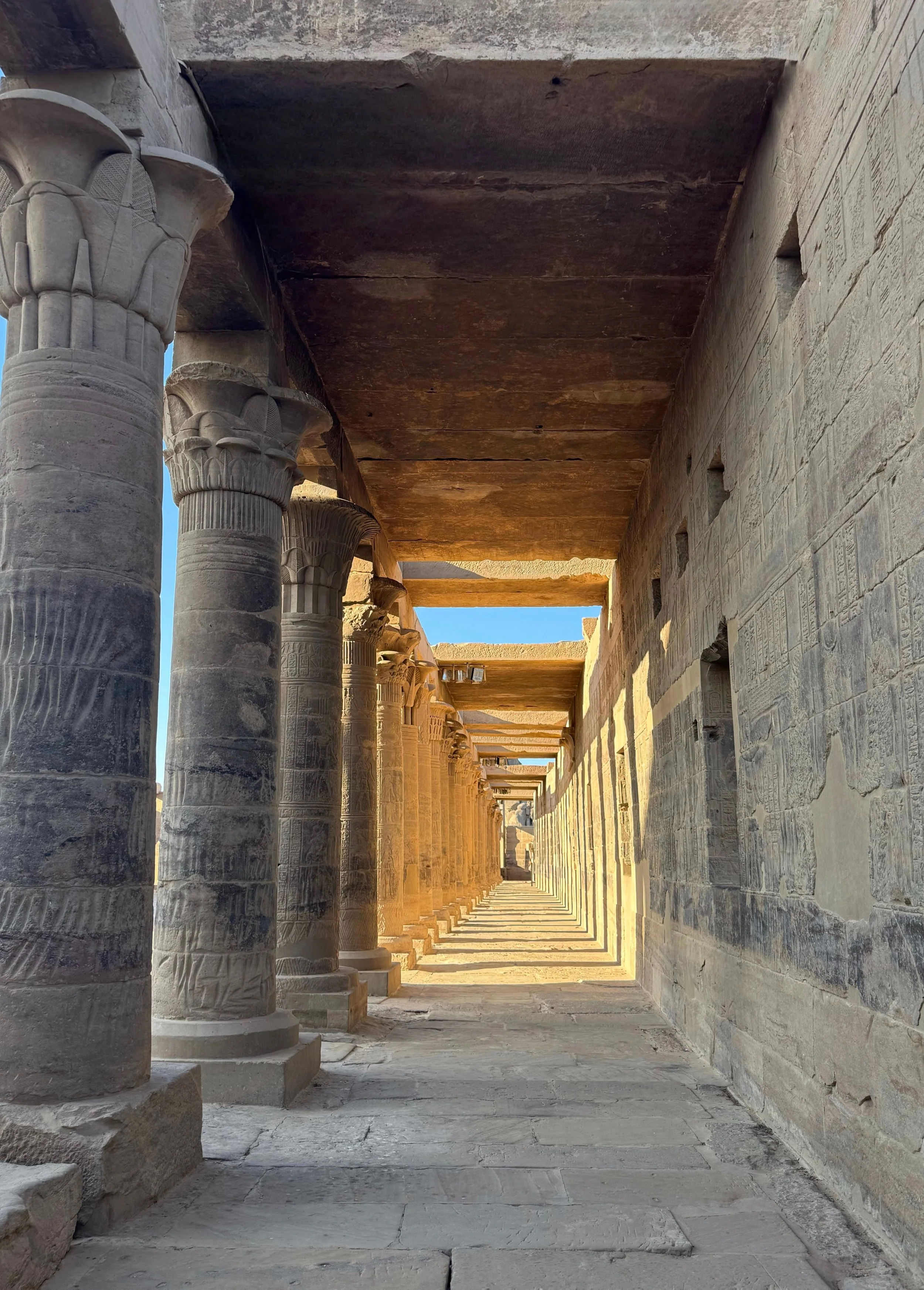
Begin your Aswan day with a boat ride to Philae, one of Egypt’s most atmospheric temple complexes. Approaching the island by water sets the tone: quiet, graceful, and anchored in centuries of devotion to Isis. Within its colonnades and inner courts, reliefs, sanctuaries, and chapels reflect a layered history that continued well into the Roman era. The setting — water, rock, and temple stone — creates a sense of clarity and stillness that makes Philae one of Upper Egypt’s most memorable sites.Unfinished Obelisk
Continue to the granite quarries to see the Unfinished Obelisk, still embedded in the bedrock where ancient craftsmen worked. Its massive scale reveals how obelisks were carved directly from the stone, with tool marks and a natural crack showing precisely why this one was abandoned. The site offers a rare and tangible view into ancient engineering and the sheer physical demands of monumental construction.Dahabeya Embarkation
Time to reset for river life. Board your dahabeya and check into your cabin. The shift from road visits to river life is immediate — quieter and slower. As the boat anchors or begins to move with the current, the Nile becomes the central axis of the journey, and the pace aligns naturally with the landscape.Meals: Breakfast, Lunch
Overnight: AswanVisits:
• Philae Temple
• Unfinished Obelisk -
Ritual Moment
River-gazing meditation from deck.Overview
A full day defined by the dahabeya’s natural pace — temple visits emerging directly from the river, with long, quiet stretches of sailing in between. Kom Ombo and Edfu anchor the day as two of Egypt’s most coherent Ptolemaic sanctuaries, approached in the traditional way: from the riverbank, on foot, and by carriage through town. Between them, the Nile carries you past cultivated edges and village life that make the ancient landscape feel continuous. The later stops shift the lens again: Gebel el-Silsila reveals where temple stone was extracted in its raw state, and Esna closes the day inside a sunken hypostyle hall layered beneath the modern town — a compressed view of time before returning to the calm of the boat.Itinerary
Morning Sailing
Awaken as the dahabeya moves north, with open deck time as the riverbanks unfold in slow repetition — palms, fields, small villages, and long horizons.Arrival at Kom Ombo – On Foot from the Riverbank
The dahabeya moors directly beside Kom Ombo. From the riverbank, the temple is reached on foot — a short, level walk that keeps the transition from river to monument immediate and seamless.Kom Ombo Temple
Arrive at Kom Ombo, uniquely built as a perfectly symmetrical double temple dedicated to two deities: Sobek, the crocodile god associated with strength and fertility, and Horus the Elder, linked to protection and kingship. Twin entrances, twin halls, and twin sanctuaries reinforce this duality. Reliefs throughout the complex illustrate offerings, rituals, and — most famously — a set of carvings interpreted as ancient medical instruments, offering insight into Ptolemaic knowledge and practice. Its location directly on the riverbank adds a dramatic setting, especially in late afternoon light.Crocodile Museum
Step inside the Crocodile Museum, located directly beside the Kom Ombo Temple — a placement that reflects its close historical connection to the cult of Sobek. Inside, a carefully curated collection displays mummified crocodiles of varying sizes, votive offerings, and ritual artifacts once dedicated to the god. The museum bridges the environment, the temple, and ancient belief: the crocodiles that once inhabited this bend of the Nile, the inscriptions carved into the temple walls, and the everyday devotion of local communities all converge here in one clear, tangible narrative.Scenic Nile Sailing
Continue sailing along the Nile, with time to observe the quiet flow of daily life along the riverbanks. Palm groves, cultivated fields, small villages, fishing boats, and occasional desert ridges create a steady visual rhythm. Sailing on a dahabeya offers a slower, more intimate view of the Nile, allowing the landscape to unfold naturally and without haste.Transfer by Horse-Drawn Carriage
Upon arrival at the Edfu riverbank, transfer by traditional horse-drawn carriage through the town to the temple entrance. This short ride reflects the historic approach to the site and remains the customary way to reach the temple.Temple of Horus at Edfu
Explore the Temple of Horus, the best-preserved major temple in Egypt. Its monumental pylons, intact chambers, and sharply carved reliefs form an exceptional example of Ptolemaic religious architecture. Inside, scenes depict the mythological battles between Horus and Seth, ceremonial processions, and temple rituals that once animated this sanctuary. The scale, clarity, and completeness of the reliefs offer a rare opportunity to read stories and symbolism exactly as ancient visitors would have seen them.Gebel el-Silsila
Disembark at Gebel el-Silsila, the primary sandstone quarry for many of Egypt’s major temple complexes, including Karnak. Sheer cliffs rise directly from the Nile, marked by ancient extraction channels and worker inscriptions. Small shrines carved into the rock suggest that even sites of labor held ritual significance. Here, the origin of temple stone is visible in its raw state.Esna Temple of Khnum
Arrive at Esna and descend into the Temple of Khnum, dedicated to the ram-headed creator god associated with the Nile’s generative power. The hypostyle hall remains remarkably preserved, with detailed astronomical ceilings and reliefs reflecting temple construction during the Ptolemaic and Roman periods. Built below modern ground level, the temple reveals layers of accumulated time within the town.Evening Onboard Dining
Dinner is served on board as the dahabeya continues its quiet course.Meals: Breakfast, Lunch, Dinner
Overnight: Private DahabeyaVisits:
• Kom Ombo Temple
• Crocodile Museum
• Edfu Temple
• Gebel el-Silsila
• Esna Temple -
Ritual Moment
Energy-alignment meditation within the Hypostyle Hall.Overview
Luxor marks the point where Upper Egypt’s river rhythm meets the full ceremonial scale of ancient Thebes. After days of sailing, the first steps onto the East Bank feel deliberate: temples designed as structured worlds where procession, kingship, and divine order were made physical. Karnak opens the day with immense architectural density — a city of courtyards, pylons, and carved stone built across centuries — before Luxor Temple carries the narrative into a more unified, river-facing sanctuary shaped for renewal rites and royal presence. By evening, returning to the dahabeya restores the quiet continuity of the Nile, letting the impressions of Thebes settle gradually.Itinerary
Morning Pickup – From Your Dahabeya
Disembark in Luxor and meet your private driver and Egyptologist for transfer to the East Bank.Karnak Temple Complex
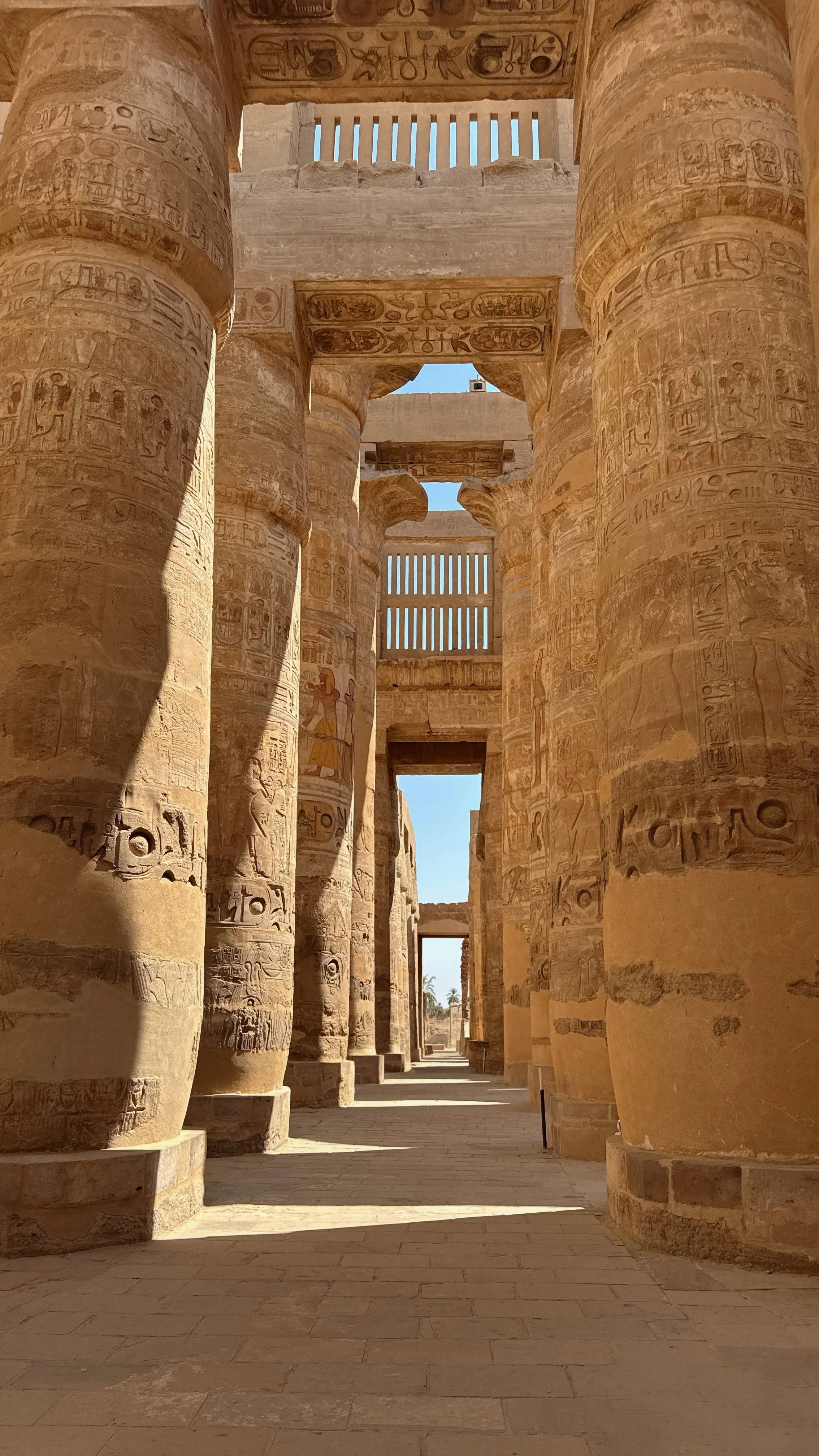
Explore the largest religious complex of ancient Egypt, dedicated primarily to Amun-Ra but expanded over more than 1,500 years by successive pharaohs. Karnak functions not as a single temple but as an immense ceremonial city — courtyards, obelisks, sanctuaries, sphinx-lined avenues, and monumental gateways. The Great Hypostyle Hall, with its 134 massive columns carved with hymns, royal names, and ritual scenes, remains one of the most powerful architectural spaces in the ancient world.Luxor Temple
Explore Luxor Temple, linked to Karnak by the ancient Avenue of the Sphinxes. Built by Amenhotep III and Ramesses II, this temple beautifully reflects the harmony of religion and royalty in ancient Egypt.Return to Dahabeya – Evening Docked in Luxor
Return to your private dahabeya for dinner while docked in Luxor. Time on deck as city lights settle along the river.Meals: Breakfast, Lunch, Dinner
Overnight: Private DahabeyaVisits:
• Karnak Temple
• Luxor Temple -
Ritual Moment
Contemplation on transformation, lineage, and rebirth.Overview
The West Bank of Luxor turns fully toward themes of transition and continuity. Beneath desert mountains, kings carved their journeys toward eternity into stone, mapping celestial rebirth across chambered walls. Nearby, queens and royal children were honored with tombs that emphasize protection, lineage, and divine renewal. This day expands the understanding of royal power — not only as authority expressed outwardly, but as continuity carried through family, theology, and memory. Architecture here moves inward, into depth, into narrative, into the idea of renewal across generations.Itinerary
Morning Disembarkation from Your Dahabeya
After breakfast, check out from your private dahabeya and disembark in Luxor. Meet your driver and Egyptologist and begin the day’s exploration on the West Bank, transitioning from river life into the desert landscape of ancient Thebes.Valley of the Kings
Enter the royal necropolis of the New Kingdom, where pharaohs were buried in elaborately decorated tombs carved deep into the desert cliffs. Inside, corridors and chambers are covered with scenes from sacred texts — celestial maps, gods, and ritual sequences guiding the king toward rebirth and eternity. The Valley reveals both the spiritual imagination and technical mastery of ancient Egypt.— Notable tombs frequently open to visitors include:
Ramses IV
Ramses III
Merenptah— Additional tombs available for visit may include:
Tutankhamun
Ramesses V & VI
Seti I
AyValley of the Queens
Continue to the Valley of the Queens, burial ground for royal women and children of the New Kingdom. The tombs here present a more intimate expression of afterlife theology, with refined compositions and protective deities guiding the deceased through transformation. The artistic detail often feels delicate and intentional, emphasizing continuity of lineage and the spiritual role of queens within dynastic stability.Your standard entry ticket allows access to three beautifully preserved tombs.
— Notable tombs often open to visitors include:
Prince Amenherkhepshef
Queen Titi
Prince Khaemwaset— Additional optional tomb available for visit:
Queen Nefertari
One of the most celebrated tombs in Egypt. Its vividly preserved wall paintings, delicate color palette, and poetic religious texts present the queen’s journey through the afterlife with exceptional clarity and grace, standing as a benchmark of New Kingdom funerary art.Temple of Hatshepsut
Conclude at the terraced mortuary temple of Hatshepsut at Deir el-Bahari. Rising in symmetrical tiers aligned with the cliffs behind it, the temple presents kingship through balance and architectural precision. Reliefs depict her divine birth and her expedition to the Land of Punt, reinforcing legitimacy through narrative and solar alignment. As one of the most powerful female rulers of ancient Egypt — and the first woman of the New Kingdom to assume full pharaonic titulary — Hatshepsut redefined the visual language of kingship during her reign.Transfer to Your Hotel in Luxor
At the end of the day’s visits, transfer across the Nile to your hotel. Check in and settle into the evening at leisure.Meals: Breakfast, Lunch
Overnight: LuxorVisits:
• Valley of the Kings
• Valley of the Queens
• Temple of Hatshepsut -
Ritual Moment
Contemplation on devotion, joy, and the continuity of sacred knowledge.Overview
This day moves beyond Thebes into two of Egypt’s most sacred and artistically refined temple complexes. Traveling through the Nile Valley, the experience unfolds as a deliberate contrast: Abydos, shaped by Osiris worship and royal memory, followed by Dendera, where Hathor’s world opens into beauty, cosmology, and ritual celebration. The drive itself becomes part of the rhythm — villages, palm groves, and cultivated fields framing these sites within the living continuity of the river.Itinerary
Morning Pickup – From Your Luxor Hotel
Begin the day with pickup from your hotel, where your Egyptologist and driver meet you for a scenic journey through the Nile Valley. The route passes villages, farmland, and palm-lined canals as you travel approximately three hours toward Abydos.Temple of Seti I at Abydos
Arrive at the Temple of Seti I, one of Egypt’s most sacred sites and traditionally associated with the cult of Osiris, god of the afterlife. Begun by Seti I and completed by Ramesses II, the temple is renowned for its finely carved and exceptionally preserved wall reliefs. Inside, explore scenes of ritual, divine procession, and kingship, including the famous Abydos King List — a chronological record of pharaohs carved into stone that anchors Egypt’s royal history.Scenic Drive to Dendera
After the visit, continue south toward Dendera. The road follows the curve of the Nile through quiet countryside and riverside villages, with everyday rural life unfolding along the way.Temple of Hathor at Dendera
Arrive at the Temple of Hathor, one of the best-preserved temples in Egypt. Dedicated to the goddess of love, music, and joy, the temple was built during the Ptolemaic period, beginning under Ptolemy XII and completed in the time of Cleopatra VII. Explore its grand hypostyle hall and richly decorated chambers, where carved ceilings, celestial motifs, and refined reliefs reflect the harmony and artistry of late Pharaonic Egypt. The site offers a striking contrast to Abydos, emphasizing beauty, cosmology, and ritual celebration.Return Transfer – To Luxor
After completing the visits, return to Luxor by private air-conditioned vehicle, arriving back at your hotel in the late afternoon or early evening.Meals: Breakfast, Lunch
Overnight: LuxorVisits:
• Temple of Seti I at Abydos
• Temple of Hathor at Dendera -
Ritual Moment
Integrating the river’s rhythm before moving forward.Overview
A clean transition day designed to carry you from Upper Egypt back to Cairo without rushing the nervous system. After the depth and steady cadence of the Nile, the flight north resets the geography in a single, efficient movement. Arrival is kept simple: a direct transfer to your airport-area hotel, and an intentionally open evening to rest, recalibrate, and prepare for the next chapter.Itinerary
Private Transfer to Luxor Airport
After breakfast and hotel check-out, your private driver transfers you to Luxor International Airport for your domestic flight to Cairo.Domestic Flight Luxor → Cairo
Fly north along the Nile corridor, shifting from Upper Egypt’s open horizons back toward the capital.Private Transfer to Your Airport-Area Hotel
Upon landing, meet your driver and transfer directly to your hotel near Cairo International Airport for check-in.Evening at Leisure
The evening is intentionally open — a quiet final pause before departure. After eleven days shaped by scale, silence, and sacred landscapes, this is the time to let the journey settle: what moved you, what softened, what clarified, and what you want to carry forward from Egypt into ordinary life.Meals: Breakfast
Overnight: Cairo Airport AreaVisits: —
THE ROUTE ON THE MAP
Note on The Cosmic AnchorWhile this entire journey is thoughtfully anchored by the total solar eclipse over Luxor on 2 August 2027, the experience is intentionally not bound to a rigid day number in this initial framework. To seamlessly accommodate varying guest arrival windows and bespoke group logistics, we maintain operational flexibility within this preliminary schedule. Once your gathering is fully confirmed and flight schedules are finalized, we will precisely calibrate the Luxor sequence to ensure absolute perfection.
INCLUSIONS
GUIDING & EXPERTISEPrivate English-Speaking Egyptologist Guide
TRANSPORTATION & LOGISTICSDedicated private driver throughout the journey
All transfers in a private air-conditioned vehicle, including airport arrivals and departures
Private boat transfer to Philae Temple
Private horse-carriage transfer to the Temple of Horus in Edfu
DOMESTIC FLIGHTSCairo → Aswan
Luxor → Cairo
SIGNATURE WATER EXPERIENCENile Cruise:
Private Dahabeya Nile Cruise Between Aswan and Luxor
ACCOMMODATION & STAY OVERVIEW3 nights in Cairo
5-star hotel
Bed & Breakfast2 nights in Aswan
5-star hotel
Bed & Breakfast3 nights aboard a private Dahabeya
Full Board2 nights in Luxor
5-star hotel
Bed & Breakfast1 night in Cairo Airport Area
Airport hotel
Bed & Breakfast
MEALS & CULINARY INCLUSIONSMeals are included as outlined in the itinerary
SELECTED HOTELS — CAIROHyatt Regency Cairo West
Cairo Marriott Hotel
Hilton Cairo Nile Maadi
Conrad Cairo Hotel & Casino
Fairmont Cairo Nile
SELECTED HOTELS — ASWANThe Zen Wellness Resort
Sonesta Nouba Hotel Aswan
BenBen by Dhara Hotels
Mövenpick Resort Aswan
Tolip Aswan Hotel
SELECTED HOTELS — LUXORSonesta St. George Hotel
Steigenberger Nile Palace
Hilton Luxor Resort & Spa
Iberotel Luxor by JAZ
SELECTED HOTELS — CAIRO AIRPORTLe Méridien Cairo Airport
Hilton Cairo Heliopolis
Waldorf Astoria Cairo Heliopolis
ACCESS & SERVICESVIP Fast-Track Airport Arrival Service (meet inside the terminal and fast-track formalities)
Private sunrise access arrangement at the Giza Plateau (subject to availability)
Entry inside the Great Pyramid of Khufu (King’s Chamber)
Private Northern Access arrangement at the Step Pyramid of Djoser
Entrance fees to all archaeological sites and museums mentioned in the itinerary
Bottled water during all guided tours and private transfers
All service charges and government taxes
A Note on Accommodation AvailabilityOne property from this curated selection will be confirmed for your journey. Final placement is subject to availability, ensuring that your experience always aligns with our rigorous standards for comfort and character.
OPTIONAL ADD-ONS
ABU SIR NECROPOLIS SACRED SITE VISITA focused visit to the Abusir pyramid field—part of the wider Memphis necropolis—known for its Fifth Dynasty monuments and a quieter, more spacious atmosphere than the main plateau sites. Access is arranged as a special, limited-entry experience, available only through prior special access coordination, offering a rare opportunity to explore this extraordinary landscape with space, calm, and depth.
CAMEL RIDE BY THE PYRAMIDSA calm, guided camel ride along the desert edge with wide views across the plateau, designed for pace, perspective, and classic photographic angles.
HORSE RIDING BY THE PYRAMIDSA guided ride through open desert trails near the plateau, combining movement, fresh air, and sweeping panoramic viewpoints in a more active rhythm than a camel ride.
SUNSET ATV EXPERIENCE BY THE PYRAMIDSA sunset quad ride across desert tracks with a short safety briefing and guided pacing, timed for the cooler hour when the landscape turns gold and the horizon opens.
LUXOR: HOT AIR BALLOON FLIGHTThe experience begins with a pre-dawn departure between 3:00 and 4:00 AM for transfer to the West Bank launch site. You lift off just before sunrise, drifting over the Nile and the monuments of the West Bank of the Luxor valley and its ancient architecture.
NUBIAN VILLAGE TOUR IN ASWANA late-afternoon river approach by boat, followed by a walk through a traditional Nubian village—brightly painted homes, river culture.
4-NIGHT HURGHADA RED SEA ALL-INCLUSIVE RESORT STAYFour nights of coastal recovery in an all-inclusive setting, paired with a Red Sea snorkeling day that highlights clear water and coral gardens—an ideal counterbalance after intensive cultural days.
EXCLUSIONS
INTERNATIONAL TRANSITAll international flights to and from Egypt. This itinerary commences upon arrival at your designated Egyptian gateway and concludes with your international departure
NATIONAL ENTRY & VISA FORMALITIESThe entry visa is the responsibility of the traveler and may be obtained online in advance (where eligible) or upon arrival
PERSONAL PROTECTIONComprehensive travel and medical insurance.
ELECTIVE EXPERIENCESSupplementary site visits, optional excursions, or personal expenditures not specifically detailed in the itinerary
TERMS OF SERVICE
RESERVATION & DEPOSITTo secure your journey, a 50% non-refundable deposit of the total trip cost is required at the time of confirmation. A reservation is considered confirmed only upon receipt of the required deposit. This deposit is applied toward your total journey investment and secures the accommodations, cruise inventory, guiding services, domestic flights, private charters, special access arrangements, and curated experiences outlined in your itinerary. All quoted prices are subject to availability and may change until the required deposit is received.
PAYMENT SCHEDULEThe remaining balance is due in full five months (150 days) prior to arrival. Timely payment ensures continuity of all secured arrangements. If final payment is not received by the due date, services may be released and payments made may be forfeited in accordance with supplier commitments and pre-paid arrangements.
CANCELLATION POLICYAll cancellation requests must be submitted in writing. The initial 50% deposit is strictly non-refundable from the moment of confirmation. As this journey includes exclusive inventory, private arrangements, and high-demand services secured well in advance, cancellations after confirmation may result in substantial penalties from hotels, charter providers, cruise operators, and other suppliers. Any additional cancellation terms beyond the non-refundable deposit will be communicated clearly within the final booking agreement where applicable.